For most of its history, Saudi Arabia's space activity was quiet and specialised: a research institute at King Abdulaziz City for Science and Technology (KACST) building small satellites, and one famous flight in 1985 when Prince Sultan bin Salman became the first Arab and first Muslim to travel to space. Since 2018 that picture has changed quickly. The Kingdom created a dedicated space body, elevated it to the Saudi Space Agency in 2023, sent two astronauts to the International Space Station, and began publishing the science they brought back.
The changes are not only about astronauts. In late November 2025, two small satellites designed by undergraduate teams from Umm Al-Qura University and Prince Sultan University reached orbit. In April 2026, a Saudi space-weather CubeSat called Shams flew on NASA's Artemis II mission. And the Communications, Space and Technology Commission (CST) now measures a national space economy of $8.7 billion, with a projection of $31.6 billion by 2035.
This article walks through the institutions, the missions, the research and the numbers, using official and published sources. It also looks at the part of the story that matters most for most Saudi businesses: space generates data, and turning that data into products is a software and AI job that can be done here, by Saudi teams.
Elbetron Builds the Software and AI That Make Data Useful
Elbetron Technologies is a Saudi technology company. We do not build satellites. What we build is the layer that sits on the ground: software, data platforms and AI that take raw data, including geospatial and imagery data, and turn it into dashboards, alerts, reports and applications that people can actually use.
That work draws on the same disciplines the space economy needs downstream: data engineering, analytics, computer vision and custom software. We also build Elbi, our bilingual Arabic and English AI assistant platform hosted inside the Kingdom, which can give teams a conversational way to query their own data.
If your organisation has data, from maps and imagery to sensors and operations, and needs a product that makes it useful, we can help you scope it, build it and run it.
From Saudi Space Commission to Saudi Space Agency
Saudi Arabia's modern space institutions are young. The Saudi Space Commission was established by Royal Order on 27 December 2018, giving the Kingdom a single body responsible for civil space activity rather than leaving it spread across research and defence entities. On 13 June 2023, a Council of Ministers resolution transformed the commission into the Saudi Space Agency, a change that came only weeks after the Kingdom's astronauts returned from the International Space Station.
The agency's stated objectives are practical rather than symbolic: to develop and localise space science and technology, promote the peaceful use of space industries, adopt proven global practices, build civilian space research expertise, and position the Kingdom as a regional and international hub for space science. Its board is chaired by the Minister of Communications and Information Technology, which signals how closely space is tied to the country's wider digital agenda.
Much of the early work focused on people. The agency lists a Space Generations Program launched in 2020 to develop Saudi talent for the sector, a Space 101 training program run with Airbus Defence and Space in 2021, and the Saudi Astronauts Program, launched in September 2022 to prepare Saudi candidates for short and long missions and in-orbit science. These programs explain why later milestones arrived so quickly: the pipeline of trained people was being built first.
It is worth separating the roles of two bodies that often appear in the same headlines. The Saudi Space Agency leads missions, research, international partnerships and talent programs. The Communications, Space and Technology Commission (CST) is the regulator, and it is CST that publishes the official market figures on the size of the Saudi space economy. Both are relevant to any company that wants to work in this sector.

- 1985: Prince Sultan bin Salman flies on Space Shuttle Discovery (STS-51-G)
- 27 December 2018: Saudi Space Commission established by Royal Order
- September 2022: Saudi Astronauts Program launched
- 13 June 2023: Commission transformed into the Saudi Space Agency
The Foundation: KACST and the SaudiSat Series
The new agency did not start from zero. KACST's Space Research Institute in Riyadh designed and built the Kingdom's first micro-satellites, SaudiSat-1A and SaudiSat-1B, which launched together on 26 September 2000 on a Dnepr rocket from Baikonur. They were technology satellites providing store-and-forward communications and hosting small experiments. SaudiSat-1C followed in December 2002.
The next step was Earth observation. SaudiSat-2, launched in 2004, was the Kingdom's first experimental Earth-observation satellite, followed by SaudiSat-3 in 2007. On 7 December 2018, SaudiSat-5A and SaudiSat-5B launched from the Jiuquan launch centre in China as KACST-designed Earth-observation satellites intended to give government agencies high-resolution imagery for urban planning and for monitoring changes on the Earth's surface. Arab News reported at the time that KACST had launched 13 satellites.
That heritage matters for two reasons. First, it means there is a generation of Saudi engineers who have already designed, integrated and operated spacecraft. Second, the SaudiSat-5 series shows where the real value of many satellites lies: in the imagery and data they send down, and in the people and software who turn that imagery into maps, alerts and decisions.

- Domestic satellite design and integration capability at KACST
- Experience with store-and-forward communications payloads
- A national Earth-observation track, from SaudiSat-2 to SaudiSat-5A/5B
- Engineers who later fed the wider Saudi space ecosystem
Axiom-2: Two Saudi Astronauts and the Research They Produced
On 21 May 2023, Axiom Mission 2 launched from NASA's Kennedy Space Center carrying Rayyanah Barnawi, a biomedical scientist, and Ali AlQarni, a Royal Saudi Air Force fighter pilot, as mission specialists alongside commander Peggy Whitson and pilot John Shoffner. Barnawi became the first Saudi woman and the first woman from the Arab world to travel to Earth orbit. The crew splashed down in the Gulf of Mexico on 30 May 2023. The Saudi Space Agency refers to the Saudi part of this flight as its first human spaceflight mission, SSA-HSF1.
The scientific return has taken longer to appear, which is normal for space research. In December 2025 the Saudi Space Agency announced results from 11 research papers, 9 national and 2 international, drawn from 19 experiments carried out by the Saudi astronauts across biomedical sciences, human health, and science and technology. The agency said further results are still being analysed and will be published later.
The reported findings are specific. A tissue-engineering experiment carried out with international partners produced a nanomaterial that the agency describes as more precise than equivalent material made on Earth. The team reported the first stem-cell gene transfer carried out in space, a blood-based biomarker study that identified indicators related to human health in space, and evidence that simple, low-cost laboratory tools can support advanced research in orbit. Six human-health experiments looked at the brain during short spaceflight, including intracranial pressure measured through pupil response, optic nerve sheath diameter, cerebral blood flow, brain electrical activity and telomere length. A cloud-seeding experiment used a new technique in microgravity to study how water vapour interacts with silver iodide, producing new data on how gravity affects condensation.
These are research findings, not medical claims. They come from a short mission with a small number of participants, and their value is in what they add to the scientific record and to the design of future studies, not in any immediate treatment. What they do show is that Saudi researchers, working with local and international institutions, were able to plan experiments, fly them, recover the samples and data, and publish. That full cycle is the capability a national research program needs.

- A space-made nanomaterial for tissue engineering, reported as more precise than its Earth-made equivalent
- The first stem-cell gene transfer carried out in space
- Six experiments on the brain and short-duration spaceflight
- A microgravity cloud-seeding experiment using silver iodide
Student Satellites: The SARI Competition
The most encouraging part of the program for many engineers is the one aimed at undergraduates. In December 2024 the Saudi Space Agency launched SARI, a competition for university students to design and build small satellites. According to the agency, 42 Saudi universities and more than 480 student teams took part. The winning teams went through technical and environmental testing and training under the supervision of agency experts and international partners.
On 29 November 2025 the agency announced that two of those student-designed satellites had been launched on an international space mission. Ufuq, from the Umm Al-Qura University team, is designed to monitor space weather and the effect of solar radiation on precise timing and navigation systems. Rawdat Scope, from the Prince Sultan University team, is designed for low-power Internet of Things communication to support environmental initiatives and connectivity in remote areas. Satellite tracking databases list both as PocketQube-class satellites deployed from a rideshare launch on 28 November 2025.
The program has continued. In May 2026 the Saudi Space Agency and Aramco Digital launched SARI 2, a second edition open to undergraduate students in STEM fields at Saudi universities, with mentorship, training, workshops and technical resources from both partners. Teams of four to five students apply together, and the agency's competition runs in phases from registration through training to the launch of a winning satellite.
For students, the difference between building a satellite on paper and building one that actually flies is large. Flight hardware forces teams to deal with power budgets, thermal limits, radio links, testing standards and deadlines that cannot move. Those are exactly the skills that transfer into any serious engineering job, whether or not the graduate stays in the space sector.
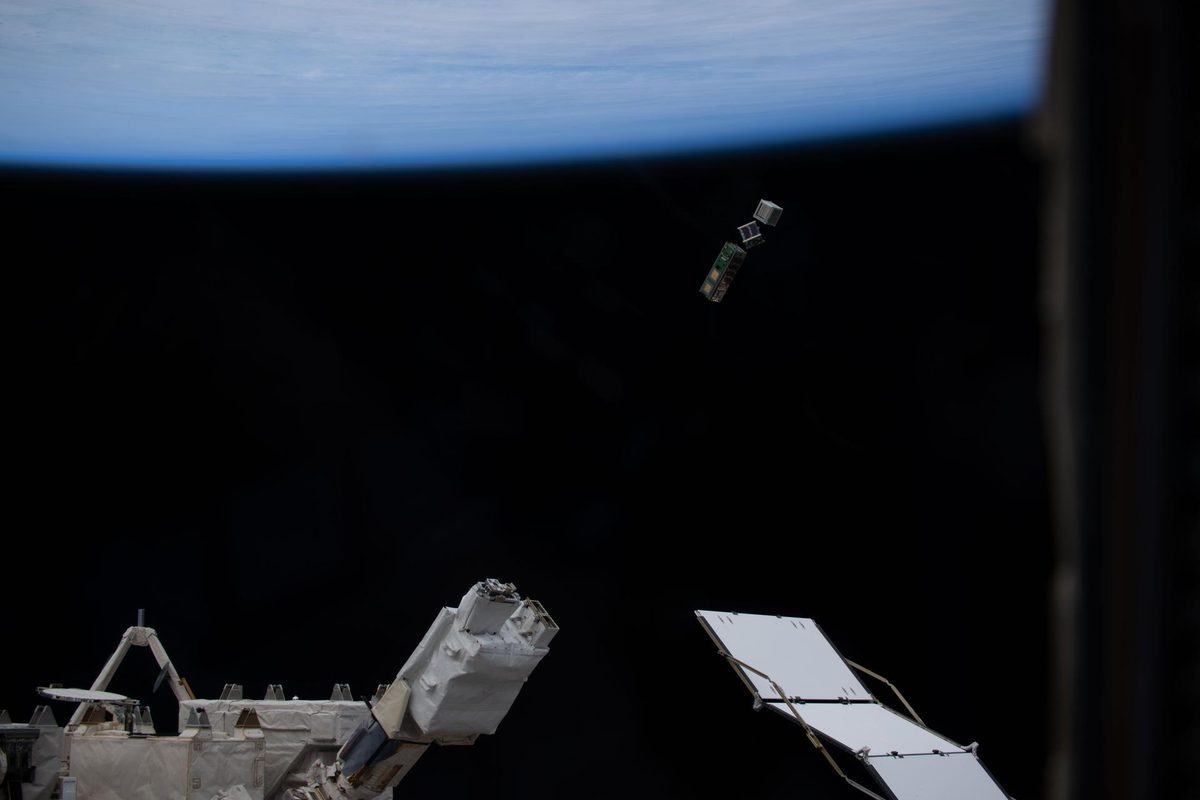
- Ufuq (Umm Al-Qura University): space weather and its effect on timing and navigation
- Rawdat Scope (Prince Sultan University): low-power IoT for remote and environmental use
- Selected from more than 480 teams across 42 universities
- Followed by SARI 2 with Aramco Digital in 2026
Shams, Artemis II and International Partnerships
Saudi Arabia signed the Artemis Accords on 14 July 2022, becoming the 21st signatory of the US-led principles for the civil exploration and use of space. The agreement was signed for the Kingdom by Mohammed bin Saud Al-Tamimi, then chief executive of the Saudi Space Commission. Two years later, in July 2024, NASA and the Saudi Space Agency signed a framework agreement for cooperation in aeronautics and the peaceful use of outer space, covering areas such as space science, exploration, Earth science and education.
That framework led to a concrete mission. In May 2025 NASA announced an agreement to fly a Saudi CubeSat on Artemis II, the first crewed flight of the Orion spacecraft around the Moon. The satellite, named Shams, is a 12U CubeSat built to study space weather at different distances from Earth by measuring space radiation, solar X-rays, solar energetic particles and magnetic fields. Artemis II launched on 1 April 2026, and on 4 April the Saudi Space Agency announced the successful launch of Shams and initial communication with it.
According to the agency, Shams was developed domestically by Saudi talent with support from the National Industrial Development and Logistics Program, and it is the first Arab mission to fly as part of the Artemis program. Its highly elliptical orbit, from about 500 km to about 70,000 km above Earth, takes it through regions that small satellites rarely sample, which is what makes its data scientifically useful.
Partnerships like these matter beyond prestige. They give Saudi engineers access to launch opportunities, mission standards and scientific communities that would take decades to build alone, and they create data sets that Saudi researchers can work with directly.

- July 2022: Saudi Arabia signs the Artemis Accords as the 21st signatory
- July 2024: NASA and the Saudi Space Agency sign a cooperation framework
- May 2025: Agreement to fly a Saudi CubeSat on Artemis II
- April 2026: Shams launches on Artemis II and makes initial contact
The Saudi Space Economy and the 2035 Outlook
The clearest official numbers come from CST's KSA Space Market 2025 report, published in April 2025. It puts the Saudi space economy at $8.7 billion in 2024, counting all value-added activities and industries built on space technologies and services. Within that, the narrower space market reached $1.9 billion. The report projects the space economy will reach $31.6 billion in 2035, a compound annual growth rate of about 12%, and the space market $5.6 billion.
For context, the same report estimates the global space economy will reach $1.8 trillion in 2035, growing about 9% a year, and the global space market will grow from $176 billion in 2024 to $377 billion in 2035. In other words, the Saudi projection assumes faster growth than the global average from a smaller base, supported by investment in space infrastructure.
Investment is arriving through state-backed vehicles as well as research programs. In May 2024 the Public Investment Fund launched Neo Space Group, a wholly owned company intended to be a national champion in the satellite and space sector. Its four units cover satellite communications, Earth observation and remote sensing, satellite navigation and IoT, and a venture capital fund focused on satellites and space. It was PIF's first investment dedicated to the space industry.
CST's report also points to where the growth is expected: Earth-observation data analysis, infrastructure services, integrated communication systems, advanced sensing and small satellites. Several of those are not about building hardware at all. They are about analysing and delivering data, which is where most of the jobs in a mature space economy sit.

- $8.7 billion Saudi space economy in 2024
- $1.9 billion Saudi space market in 2024, projected $5.6 billion in 2035
- $31.6 billion space economy projected for 2035 at about 12% annual growth
- Neo Space Group launched by PIF in May 2024 with four business units
What It Means for Saudi Engineers and Tech Companies
Most people who work in a space economy never touch a rocket. Satellite operators need ground software, mission planning and telemetry tools. Earth-observation data has to be cleaned, catalogued and analysed before anyone can act on it. IoT satellites like Rawdat Scope only matter if someone builds the dashboards and applications that use their signals. The CST report's emphasis on data analysis, communications and sensing is a reminder that the downstream side is where a large share of the value is created.
For Saudi software engineers and data scientists, that opens practical work: computer vision on satellite and aerial imagery to detect changes in land use, construction, vegetation or water; geospatial data pipelines that combine imagery with maps and sensor feeds; forecasting tools that use space-weather data for timing-sensitive systems; and Arabic-first interfaces that let non-specialists in government and industry ask questions of these data sets. None of this requires building a satellite. It requires solid engineering, good data practice and AI that is tested on real local conditions.
For students, the SARI competitions show a realistic path: learn embedded systems, radio and software on a real flight project, then carry those skills into either the space sector or any engineering-heavy industry. For companies, the useful question is not whether to enter the space business, but which of their existing decisions could be improved with geospatial or satellite-derived data, and who will build the software that delivers it.
There are honest limits. Satellite data can be expensive, licensing terms vary, and models trained on imagery from other regions often perform worse on Saudi terrain, light and urban patterns. Projects work best when they start with a specific decision, a clear data source and a way to measure whether the output is right.
- Computer vision for change detection on satellite imagery
- Geospatial data pipelines and dashboards for operations teams
- Applications built on satellite IoT and navigation signals
- Arabic and English interfaces that make space data usable by non-specialists
Frequently Asked Questions
What is the Saudi Space Agency?
The Saudi Space Agency is the government body that leads Saudi Arabia's civil space activities, including missions, research, international partnerships and talent programs. It was established as the Saudi Space Commission by Royal Order on 27 December 2018 and transformed into the Saudi Space Agency by a Council of Ministers resolution on 13 June 2023. Its objectives include localising space science and technology and making the Kingdom a regional and international hub for space science.
Who were the Saudi astronauts on Axiom-2, and what did they achieve?
Rayyanah Barnawi, a biomedical scientist, and Ali AlQarni, a Royal Saudi Air Force fighter pilot, flew as mission specialists on Axiom Mission 2, which launched on 21 May 2023 and returned on 30 May 2023. Barnawi became the first Saudi woman and the first woman from the Arab world in Earth orbit. In December 2025 the Saudi Space Agency announced results from 11 research papers based on 19 experiments from the mission.
What research results came from the Saudi biological samples and experiments in space?
The Saudi Space Agency reported a tissue-engineering nanomaterial made in space that it describes as more precise than its Earth-made equivalent, the first stem-cell gene transfer carried out in space, a blood-biomarker study, six experiments on the brain during short spaceflight, and a cloud-seeding experiment using silver iodide in microgravity. These are research findings from a short mission, not medical treatments, and the agency says more results are still being analysed.
Which Saudi student satellites have been launched?
Two satellites from the Saudi Space Agency's SARI competition were announced as launched on 29 November 2025: Ufuq, designed by a team from Umm Al-Qura University to monitor space weather and its effect on timing and navigation, and Rawdat Scope, designed by a team from Prince Sultan University for low-power Internet of Things communication. The competition drew more than 480 teams from 42 Saudi universities. A second edition, SARI 2, was launched with Aramco Digital in May 2026.
What is the Shams satellite?
Shams is a 12U Saudi CubeSat designed to study space weather, measuring space radiation, solar X-rays, solar energetic particles and magnetic fields. It flew as a secondary payload on NASA's Artemis II mission, which launched on 1 April 2026, and the Saudi Space Agency announced initial communication with it on 4 April 2026. The agency describes it as developed domestically by Saudi talent and as the first Arab mission in the Artemis program.
How big is the Saudi space economy, and what is the 2035 target?
According to the Communications, Space and Technology Commission's KSA Space Market 2025 report, the Saudi space economy reached $8.7 billion in 2024, with the narrower space market at $1.9 billion. The report projects the space economy will reach $31.6 billion in 2035, a compound annual growth rate of about 12%, and the space market $5.6 billion.
Is Saudi Arabia part of the Artemis Accords?
Yes. Saudi Arabia signed the Artemis Accords on 14 July 2022, becoming the 21st signatory. In July 2024 NASA and the Saudi Space Agency also signed a framework agreement for cooperation in aeronautics and the peaceful use of outer space, which was followed by the agreement to fly the Shams CubeSat on Artemis II.
What careers does the Saudi space sector create for software and AI engineers?
Beyond satellite engineering, a space economy needs ground software, mission and telemetry tools, geospatial data pipelines, computer vision on satellite imagery, and applications built on satellite communications, navigation and IoT. CST's market report highlights Earth-observation data analysis and integrated communication systems as growth areas, which are largely software and data roles that Saudi engineers can work in without building hardware.
Conclusion
Saudi Arabia's space program has moved from a small research effort to a connected system in a short time: an agency formed in 2023, two astronauts whose experiments have produced eleven published research papers, student satellites in orbit, a CubeSat on a Moon mission, and a regulator measuring an $8.7 billion space economy with a $31.6 billion outlook for 2035.
The opportunity for most Saudi engineers and companies lies on the ground. Every new satellite, experiment and partnership produces data, and the Kingdom will need many people who can turn that data into software, models and decisions. That work is already within reach of Saudi teams today.
Photo credits: NASA (public domain)
How Elbetron Can Help
Services directly related to what you just read