What Is an AI Assistant — and Why It Matters Now
An AI assistant is a software system powered by large language models, natural language processing, and increasingly, multimodal capabilities — able to understand spoken or written input, reason about it, and respond in human-like language. Unlike rule-based chatbots that follow rigid scripts, modern AI assistants learn from context, handle unexpected questions, maintain conversation memory, and operate across Arabic and English without switching modes.
For Saudi Arabia, this distinction is not academic. The Kingdom's Vision 2030 initiative demands a fundamental reimagining of how citizens interact with government, how businesses serve customers, and how organizations manage internal knowledge. AI assistants are the most human-facing expression of that transformation — the interface between AI infrastructure and everyday people.
Between 2022 and 2026, AI assistant deployments across the GCC grew by over 340%, with Saudi Arabia accounting for the majority of that growth. The catalyst was not one policy or product but the convergence of affordable cloud infrastructure, the maturation of Arabic NLP models, and Vision 2030's explicit budget allocations for AI-led public services.
Saudi Arabia's AI Transformation in Numbers
Saudi Arabia's commitment to artificial intelligence is not aspirational rhetoric — it is backed by some of the most significant investment figures in the world. Understanding the scale of this commitment is essential to grasping why AI assistants are moving from pilot project to national infrastructure.
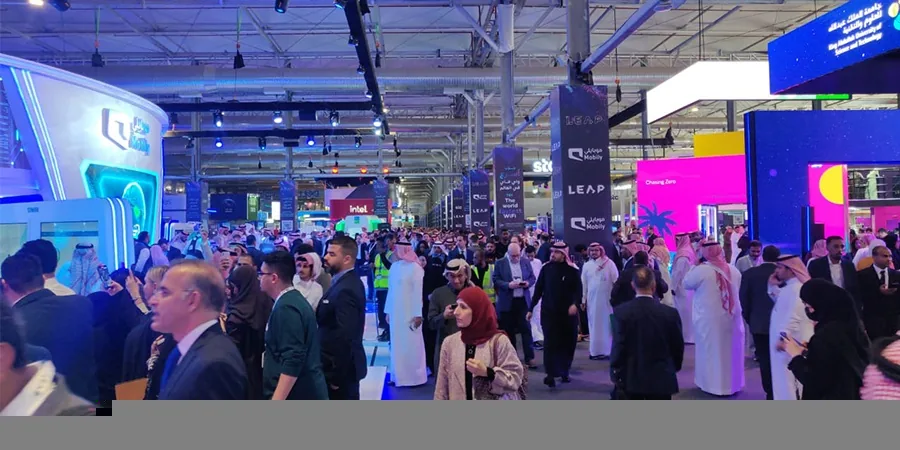
The Public Investment Fund (PIF) launched HUMAIN in 2025, a dedicated AI company with a mandate to deploy 500 megawatts of AI compute capacity and establish the Kingdom as a global AI leader. The Saudi Data and Artificial Intelligence Authority (SDAIA) manages the National Data Management Office and oversees hundreds of AI projects across ministries. Meanwhile, LEAP, the world's largest tech conference held annually in Riyadh, attracted over $14 billion in investment pledges at its most recent edition.
These macro investments flow directly into AI assistant deployments. Government ministries are mandating conversational AI for citizen services. Banks are replacing first-line call centre agents with voice-enabled AI. Retailers are deploying Arabic-speaking shopping assistants. Hospitals are piloting AI triage assistants that reduce emergency room intake times by up to 40%.

Saudi Arabia pledges $100B+ in AI investment by 2030 — LEAP 2025, Riyadh
Vision 2030's Digital Backbone
Vision 2030 is not a single technology program — it is a national identity transformation, a restructuring of how Saudi Arabia creates and distributes economic value. But embedded within its pillars is a clear digital thesis: government must be digital-first, businesses must be data-driven, and citizens must be served by intelligent systems that meet them where they are.
The Saudi Digital Authority (SDA) coordinates digital transformation across public entities, while the National Cybersecurity Authority (NCA) sets the data governance frameworks that AI deployments must comply with. The Personal Data Protection Law (PDPL), enacted in 2021 and enforced with increasing rigour since 2023, governs how AI assistants store, process, and share citizen data.
For AI assistants specifically, Vision 2030 created direct demand in three ways: it mandated that a minimum percentage of government services be accessible 24/7 (achievable only with AI), it funded the Arabic language infrastructure needed for high-quality NLP, and it created the NEOM and Qiddiya smart city projects that require ambient AI assistance as a core urban feature.
Vision 2030 & AI
Vision 2030's e-Government program targets making 90% of government services available digitally — AI assistants are the primary interface delivering that access to citizens.
 Government
Saudi Arabia's digital government platforms — Absher, Mawid, Etimad, Nafath — are AI-powered at their core
AI Assistants in Government & Public Services
The Saudi government has moved faster than almost any other public sector globally in deploying AI assistants at scale. The Absher platform — which handles passport, traffic, and civil registration services — integrated an AI assistant that now handles over 60% of user queries without human escalation. Etimad, the government procurement platform, uses AI to guide vendors through complex tendering processes in both Arabic and English.
Mawid, the national healthcare appointment booking system, uses an AI assistant to pre-triage patients and route them to the appropriate specialist, reducing average booking time from 11 minutes to under 90 seconds. The Ministry of Human Resources deployed a bilingual AI assistant to handle labor law queries from both employers and workers — processing over 2 million inquiries in its first year.
What makes these deployments particularly significant is their Arabic-first design. Citizens who have historically been excluded from digital services due to limited English proficiency or low digital literacy now access government systems through natural spoken Arabic — a shift with profound social and economic implications.
✦ Key Government AI Deployments
- Absher: AI assistant handling 60%+ of citizen queries
- Mawid: booking time reduced from 11 min to 90 seconds
- Ministry of HR: 2M+ labor law queries handled in year one
- Etimad: bilingual procurement guidance for 180,000+ vendors
- Nafath: AI-powered digital identity verification assistant
 Enterprise & Banking
Al Rajhi Bank, SNB, and Saudi enterprises lead GCC adoption of enterprise AI assistants
AI Assistants in Enterprise & Banking
Saudi Arabia's banking sector — led by Al Rajhi, SNB, Riyad Bank, and SABB — has been among the fastest adopters of AI assistant technology. The drivers are familiar: call centre costs, 24/7 service expectations, and a young, mobile-first customer base that expects instant, intelligent responses.
Al Rajhi Bank, the world's largest Islamic bank by assets, deployed a voice-enabled AI assistant capable of handling account inquiries, fund transfers, loan eligibility checks, and investment product explanations — all in colloquial Saudi Arabic. SNB's AI assistant handles over 1.5 million monthly interactions with a resolution rate above 85%, allowing human agents to focus exclusively on complex cases.
Beyond banking, enterprise adoption spans retail, hospitality, oil & gas, and logistics. SABIC uses an AI assistant to guide plant operators through safety protocols and maintenance procedures. Saudia's AI assistant manages flight rebooking for disrupted passengers at scale, handling volume spikes during peak travel seasons that would require dozens of additional human agents.
The ROI case is compelling: enterprises consistently report 60–75% reductions in cost-per-interaction and 3× improvements in first-contact resolution rates after deploying AI assistants. The payback period is typically under six months for mid-to-large scale deployments.
✦ Enterprise AI Assistant Impact
- Al Rajhi: full-service voice assistant in colloquial Arabic
- SNB: 1.5M monthly interactions, 85%+ resolution rate
- SABIC: AI-guided safety and maintenance protocols
- Saudia: automated rebooking during peak disruptions
- 60–75% average cost-per-interaction reduction across sectors
 Healthcare
AI is transforming patient intake, triage, pharmacy, and mental health services across Saudi Arabia's healthcare system
AI Assistants in Healthcare
Saudi Arabia's healthcare system is undergoing a parallel transformation driven by Vision 2030's goal to raise the private sector's share of healthcare delivery from 40% to 65% by 2030. AI assistants are central to this shift — reducing administrative burden, improving patient communication, and extending the reach of a healthcare system serving over 35 million people.
King Faisal Specialist Hospital & Research Centre deployed an AI triage assistant that pre-screens incoming patients, collects symptom data, assesses urgency, and routes them to the appropriate department — all before they speak to a human. Emergency department intake times dropped by 38% in the first six months.
Pharmacy chains including Nahdi and Al-Dawaa have deployed medication assistant chatbots that handle prescription queries, drug interaction warnings, refill reminders, and insurance pre-authorization — available 24 hours a day in Arabic and English. For patients managing chronic conditions, this level of always-on support has measurable outcomes on medication adherence.
Mental health is another frontier. The cultural sensitivities around mental health discussions in Saudi Arabia make anonymous AI assistants an important bridge — allowing individuals to access psychoeducational content and self-assessment tools without stigma. Saudi startups and hospital networks alike are investing in this space.
✦ Healthcare AI Applications
- King Faisal Hospital: 38% reduction in ER intake time
- Nahdi & Al-Dawaa: 24/7 bilingual pharmacy assistants
- Mawid: AI pre-triage cutting booking time by 87%
- Mental health: anonymous AI bridges stigma gap
- Remote patient monitoring with AI-driven alert assistants
 Retail & E-Commerce
Saudi Arabia's e-commerce sector is projected to exceed SAR 50B by 2027 — AI assistants are the competitive edge
AI Assistants in Retail & E-Commerce
Saudi Arabia's e-commerce sector is one of the fastest-growing in the MENA region, projected to exceed SAR 50 billion by 2027. AI assistants are the competitive differentiator: they guide purchase decisions, manage returns, handle loyalty queries, and drive upsell — all without adding headcount.
Noon, the region's largest homegrown e-commerce platform, uses an AI shopping assistant that understands product queries in Arabic dialects, makes personalised recommendations based on browsing history, and reduces cart abandonment through proactive engagement. Jarir Bookstore's AI assistant handles complex technical product comparisons — laptops, gaming hardware, educational materials — in real time.
Luxury retail is catching up. Brands in Riyadh's Boulevard City and Al Nakheel Mall are experimenting with AI assistants that handle pre-visit styling consultations via WhatsApp, converting consideration to footfall. The integration of AI with loyalty programs — where the assistant knows your purchase history, tier status, and preferences — creates a hyper-personalized experience that drives repeat visits.
In quick-service restaurants, McDonald's Saudi Arabia and Kudu are using AI assistants for drive-through and in-app ordering — handling dialect variations, meal customizations, and real-time availability — with measurable improvements in order accuracy and throughput.
✦ Retail AI Assistant Use Cases
- Noon: dialect-aware product discovery and cart recovery
- Jarir: real-time technical product comparison in Arabic
- Luxury retail: pre-visit AI styling consultations
- QSR chains: AI drive-through ordering with dialect handling
- Loyalty programs: hyper-personalized AI engagement layers
The Arabic-First Imperative
No discussion of AI assistants in Saudi Arabia is complete without addressing the Arabic language challenge — and opportunity. Modern Standard Arabic (MSA) and Saudi colloquial Arabic (Najdi, Hejazi, Gulf dialects) are linguistically distinct enough that a system trained on MSA alone will fail to serve a large portion of the Saudi population.
Until 2023, the Arabic NLP ecosystem was significantly behind English. Training data was sparse, dialect coverage was minimal, and commercial Arabic LLMs were virtually non-existent. That landscape has changed dramatically. SDAIA's Arabic Language Center, university research partnerships, and private sector investment have produced Arabic-native language models capable of handling the full spectrum of Saudi dialect variation.
For businesses and government entities deploying AI assistants in Saudi Arabia, Arabic-first design is not a feature — it is a regulatory and commercial necessity. The National E-Government Policy explicitly requires Arabic language support for all citizen-facing digital services. And from a commercial standpoint, studies consistently show that Saudi consumers are 3× more likely to complete a transaction when interacting in their native dialect.
This creates a competitive moat for organizations that invest in genuinely Arabic-capable AI assistants — and a significant risk for those who deploy English-first systems with superficial Arabic translation layers on top.
Arabic AI Capability Milestones
- SDAIA's Arabic Language Center: national NLP infrastructure
- Saudi dialect coverage: Najdi, Hejazi, Gulf now commercially viable
- 3× higher transaction completion in native dialect vs translated UI
- NEOM AI ambient systems designed Arabic-first from the ground up
- Arabic voice synthesis: natural TTS now available for KSA market
Challenges to AI Assistant Adoption
Despite extraordinary momentum, AI assistant adoption in Saudi Arabia faces real structural challenges that organizations must navigate carefully.
Data Sovereignty & PDPL Compliance
Saudi Arabia's Personal Data Protection Law requires that citizen data be processed and stored within the Kingdom. Many global AI assistant vendors store data in European or US data centres — creating compliance risk for regulated industries like banking, healthcare, and government.
Dialect Coverage Gaps
While Arabic NLP has advanced significantly, certain regional dialects and code-switching patterns (mixing Arabic with English mid-sentence) still challenge even advanced models. Continuous fine-tuning on Saudi-specific conversation data is essential.
Change Management & User Trust
Saudi consumers and employees have high expectations for service quality. An AI assistant that misunderstands cultural context, uses inappropriate formality levels, or fails to escalate when needed will erode trust rapidly — and recovery is difficult.
Integration Complexity
Most large Saudi enterprises operate complex legacy ERP and CRM systems — Dynamics 365, SAP, Salesforce, Oracle. Integrating AI assistants with these systems to enable real-time data retrieval (account balances, order status, appointment slots) requires significant integration engineering.
How Elbetron's Elbi Platform Powers This Shift
Elbetron built Elbi specifically for the Saudi and GCC market — addressing the structural challenges above with an architecture designed from day one for Arabic-first, data-sovereign, enterprise-grade AI assistant deployment.
Elbi is a full-stack agentic AI platform: it supports voice-to-voice conversations with custom branded Arabic and English voices, multi-agent deployment (separate personas for Sales, Support, HR, Finance), a real-time analytics dashboard with sentiment and intent classification, and self-hosted deployment that keeps all conversation data within the client's own infrastructure.
Arabic Voice-to-Voice
Full duplex voice conversations in Saudi Arabic dialects and MSA — with custom branded TTS voices per agent, deployed on your own servers.
Multi-Agent Fleet
Deploy Sales, Support, HR, and Finance agents simultaneously — each with distinct personality, knowledge base, and voice — from a single dashboard.
Real-Time Analytics
Sentiment scoring, intent classification, topic clustering, speech analytics, and live system health — all in one command center.
Data Sovereignty
Self-hosted inside the Kingdom, including on your own infrastructure. Conversation data never leaves your servers — PDPL compliant by architecture.
What differentiates Elbi is the speed of deployment without sacrificing depth. Most enterprise AI assistant projects take 6–18 months to go live. Elbi's structured onboarding playbook — discovery, knowledge base ingestion, widget branding, integration, QA, and launch — compresses that timeline to under one week for standard deployments.
Conclusion: The Conversation Has Only Begun
AI assistants in Saudi Arabia are not a trend or a pilot program category — they are rapidly becoming core infrastructure, as fundamental to digital service delivery as a mobile app or a website. The organizations that deploy them well, with genuine Arabic language capability, strong data governance, and thoughtful user experience design, will define customer and citizen experience standards for the next decade.
Saudi Arabia's unique combination of government ambition, private sector dynamism, a young digitally-native population, and the Arabic language imperative creates a market where AI assistants will be deployed at a scale and speed unlike almost anywhere else in the world.